
Since April 1, 2025, a quiet but significant shift has taken effect across the textile industry. OEKO-TEX STANDARD 100, one of the most widely recognized certifications for textile safety, no longer accepts recycled PET derived from plastic bottles as qualifying recycled content in certified products.
For brands that have spent years building recycled content claims on bottle-to-fiber polyester, the implication is direct: that content no longer qualifies under one of your most important certification marks.
What Changed and Why
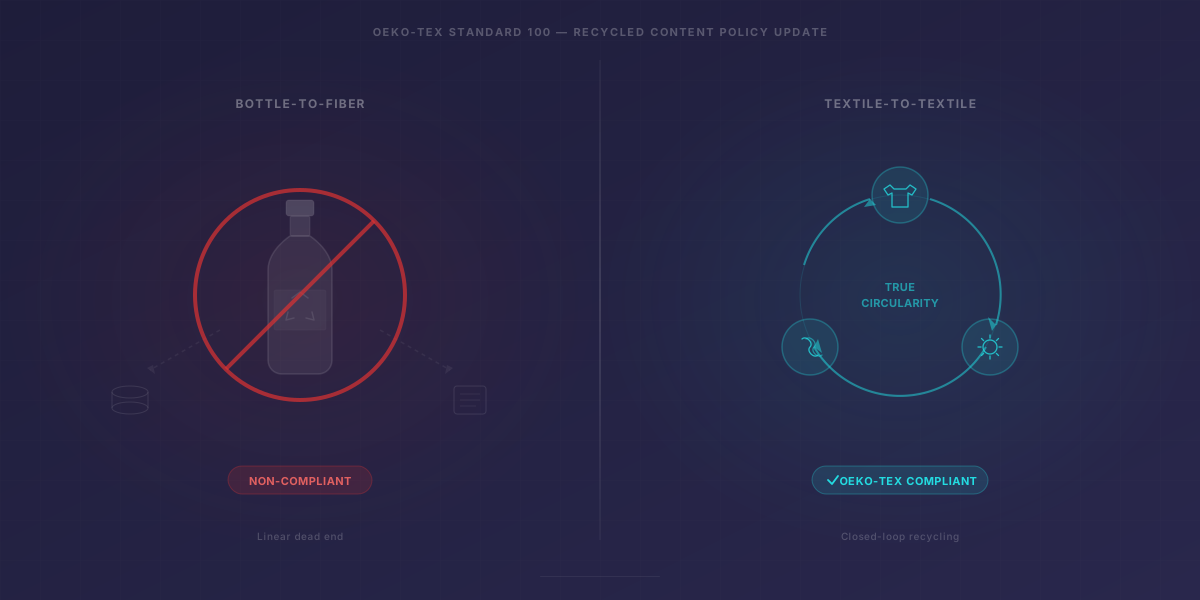
OEKO-TEX's decision reflects a growing scientific and policy consensus: recycling plastic bottles into textile fiber is not textile recycling. It is a diversion of material from one waste stream into another, ultimately producing a fiber that cannot itself be recycled back into polyester at end of life.
The concern is circularity — or the lack of it. Bottle-derived recycled polyester enters the textile system but cannot exit it cleanly. It mixes with dyes, finishes, and other fiber types, becoming progressively harder to recycle with each use cycle. The result is a material that carries a recycled content claim without contributing to a genuinely circular system.
OEKO-TEX's updated standard draws a line between material that closes a loop and material that simply delays landfill.
What This Means for Certified Products
Any product bearing OEKO-TEX STANDARD 100 certification that relies on bottle-derived rPET for its recycled content claim is now out of compliance with the standard's intent. Brands with certification renewal cycles in 2025 or 2026 will need to demonstrate compliant sourcing or remove the certification.
This affects a substantial portion of the market. Bottle-to-fiber has been the dominant form of recycled polyester for over a decade, largely because it was cost-competitive and available at scale. The supply chain for genuinely circular, textile-to-textile recycled polyester has, until recently, not existed at comparable scale.
The Compliant Alternative: Textile-to-Textile Recycled Content
Post-consumer textile recycling, specifically textile-to-textile (T2T) processes that convert waste garments into new polyester fiber, represents the category that OEKO-TEX's updated standard is designed to recognize and reward.
T2T recycled polyester starts as a discarded garment, passes through sorting, depolymerization, repolymerization, and extrusion, and arrives at the fabric mill as a fiber chemically equivalent to virgin polyester. Critically, the resulting fiber can itself be recycled again at end of life, closing the loop that bottle-derived fiber cannot.
For brands holding or pursuing OEKO-TEX certification, sourcing from a verified T2T supply chain is now a compliance requirement, not just a sustainability preference.
Traceability Is Non-Negotiable
OEKO-TEX and the broader regulatory environment are moving in lockstep: claims require documentation. Saying your product contains post-consumer recycled textile fiber is no longer sufficient. Brands need supply chain records that trace the material from collection point through each processing stage to the finished fabric.
Technologies like Aware™ — physical tracers embedded in feedstock at the point of collection — provide this chain of custody in a form that auditors and certification bodies can verify. Without traceable sourcing, recycled content claims remain vulnerable regardless of how genuine the underlying process is.
What Brands Should Do Now
Brands currently relying on bottle-derived rPET for OEKO-TEX certified lines should begin the transition now. The practical steps are straightforward: audit which product lines carry the certification and what recycled content they rely on, identify T2T-certified suppliers with GRS documentation and Aware™ or equivalent traceability, and phase bottle-derived content out of certified SKUs ahead of the next certification review.
The supply of GRS-certified, traceable T2T recycled polyester is available today at industrial scale. The constraint is no longer supply. It is sourcing decisions.
Looking Ahead
The OEKO-TEX bottle ban is the leading edge of a broader regulatory shift. The EU's phased recycled content mandates, the Digital Product Passport requirements taking effect from 2027, and Extended Producer Responsibility obligations arriving in 2028 all point in the same direction: recycled content claims will need to be circular, documented, and verifiable.
Brands that make the transition to T2T sourcing now are not just solving a compliance problem. They are positioning their supply chains for a regulatory environment that will only become more demanding.
Weavive operates a GRS-certified, Aware™-traced textile-to-textile recycling ecosystem with 100,000+ tons/year feedstock capacity. Contact us to discuss compliant T2T sourcing for your product lines.