The EU's approach to textile sustainability has moved from policy discussion to binding law. Across the next three years, a set of interconnected regulations will reshape what it means to produce, sell, and dispose of textile products in or into the European market. For brands with EU operations or EU-facing supply chains, understanding the timeline is now a sourcing and operations question, not just a compliance one.
Here is what is in effect, what is coming, and what each regulation actually requires.
Already in Effect: The OEKO-TEX Bottle Ban (April 2025)
While not an EU regulation in the legislative sense, OEKO-TEX STANDARD 100's decision to remove recycled PET bottle content from qualifying recycled content in certified products took effect on April 1, 2025, and functions as a de facto market requirement for brands that rely on the certification.
The practical consequence: brands using bottle-derived rPET in OEKO-TEX certified lines need to replace that content with post-consumer textile recycled fiber to maintain certification. This is the first major signal that the definition of "recycled" is tightening, with circularity as the new standard.
July 2026: The EU Destruction Ban
Starting July 2026, EU brands will be prohibited from destroying unsold textile and clothing products. This applies to goods that have been placed on the EU market and returned or remain unsold at end of season.
The destruction ban forces brands to find certified end-of-life pathways for surplus inventory. Donation is one route, but capacity is limited and donation increasingly faces its own scrutiny. Certified recycling is the scalable answer, and brands will need documented evidence that unsold goods went to a verified recycler, not a landfill or incinerator.
For brands without established take-back and recycling partnerships, July 2026 is a hard deadline. Building those relationships takes time. Certification audits, supply chain documentation, and logistics arrangements cannot be stood up in a few weeks.
2027–2028: Digital Product Passport (DPP)
The EU's Ecodesign for Sustainable Products Regulation (ESPR) introduces the Digital Product Passport, a machine-readable record attached to each product that documents its materials, recyclability, repairability, and environmental footprint. Textiles are among the first product categories in scope, with implementation expected from 2027.
The DPP does not just require brands to know what is in their products. It requires them to prove it, with documentation traceable to the source. A claim that a garment contains 30% post-consumer recycled polyester will need to be backed by supply chain records showing where that polyester originated, how it was processed, and what certifications it carries.
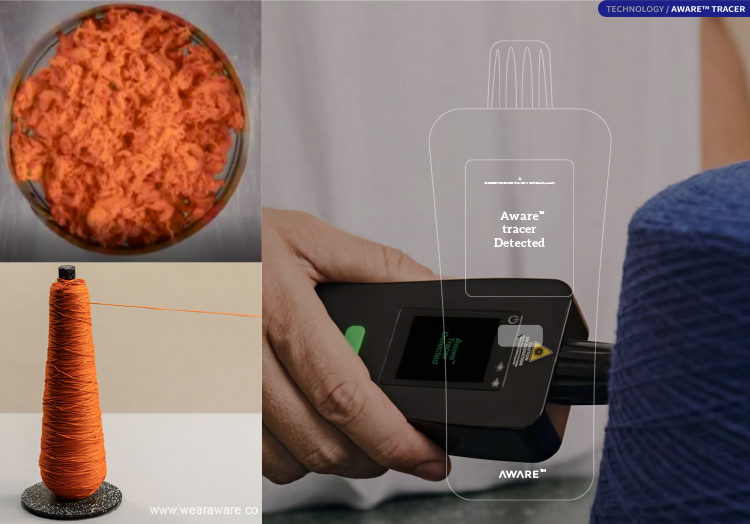
This is where physical tracer technologies like Aware™ become infrastructure rather than a nice-to-have. Tracers embedded at the feedstock collection stage create a verifiable chain of custody that persists through depolymerization, repolymerization, and fiber production. Without that thread of documentation, DPP compliance for recycled content claims will be difficult to substantiate.
2028: Extended Producer Responsibility (EPR)
The EU's EPR framework for textiles, expected to take full effect by 2028, makes brands financially responsible for the end-of-life management of the products they place on the market. Brands will be required to contribute to textile collection and recycling infrastructure, either by joining a producer responsibility organization or by demonstrating their own certified take-back capacity.
EPR reframes the economics of textile recycling. Rather than recycling being a cost borne entirely by recyclers or governments, brands will carry a share of that cost proportional to their market volume. Brands that have already invested in take-back programs and certified recycling partnerships will have a compliance advantage. Those that have not will be subject to fees and levies that are still being structured by EU member states.
The practical implication: brands should treat EPR not as a 2028 problem but as a 2026 sourcing decision. Supply chain partnerships, certification agreements, and take-back logistics need to be in place well before the obligation date.
Phased Recycled Content Mandates
Alongside EPR, the EU is introducing minimum mandatory recycled content thresholds for textile products:
- 10% recycled content minimum from 2025
- 15% from 2027
- 30% from 2030
These thresholds apply to recycled content as defined under the evolving regulatory framework, meaning post-consumer textile recycled fiber will qualify while bottle-derived rPET may face increasing restrictions. Brands planning their product development roadmaps for 2027 and beyond need to be sourcing T2T recycled content now to have the supply chain in place when the thresholds take effect.
The Common Thread
Each of these regulations points to the same underlying requirement: recycled content must be genuinely circular, demonstrably traceable, and produced through certified processes. The era of broad-brush recycled content claims, without supply chain documentation to back them up, is ending.
For brands, the transition requires three things: sourcing relationships with certified T2T recyclers, traceability systems that can provide the documentation DPP and EPR audits will require, and enough lead time to build those relationships before the deadlines arrive.
The brands that move early will have supply chain advantages that latecomers cannot replicate quickly. GRS-certified, Aware-traced T2T recycled fiber is available at industrial scale today. The question is whether brands will build the sourcing relationships before the regulations make it urgent, or after.
Weavive's T2T recycling ecosystem is GRS-certified across the full chain, with Aware™ tracer technology enabling end-to-end material provenance documentation. Contact us to discuss how our supply chain integrates with your EU compliance roadmap.